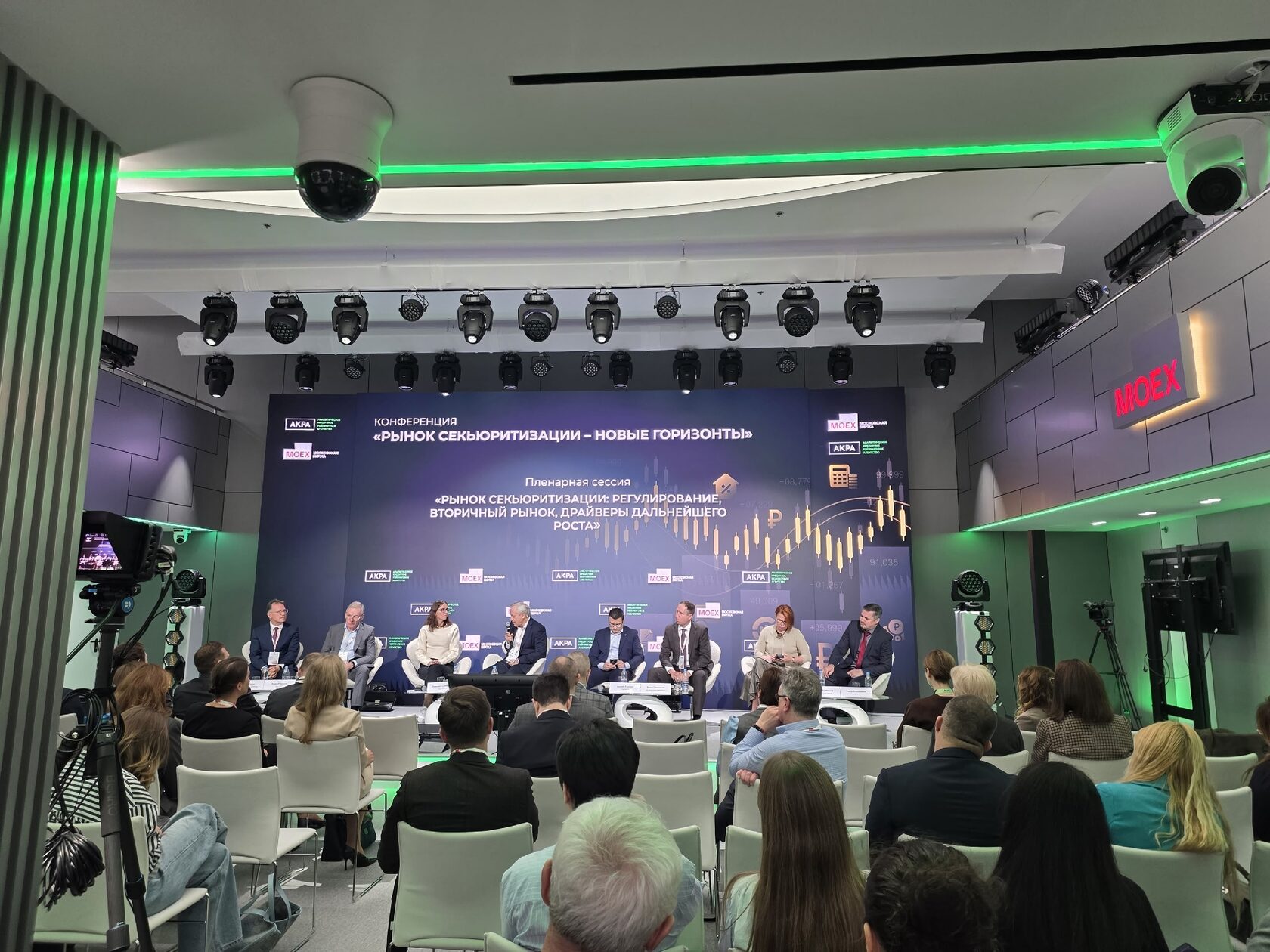
On September 30, representatives of the Eurasian Business Alliance attended the “Securitization Market - New Horizons” conference organized by ACRA in cooperation with Moscow Exchange. The discussions focused on the development of Russia’s securitization market, expanding the investor base, and improving liquidity for new financial instruments.
The conference was held at Moscow Exchange and brought together representatives of the Bank of Russia, leading Russian banks, investment companies, rating agencies, and the expert community.
The event focused on the current state and prospects of Russia’s securitization market, including regulation, secondary-market liquidity, expansion of the investor base, key drivers of further growth, and some of the most notable securitization transactions of the past year.
The Eurasian Business Alliance was represented by President Andrey Morozov; First Vice President Evgeny Shimanovsky; and Alexander Torshin, Chairman of the Alliance’s Board of Trustees, Chairman of the Board of Directors of the Eurasian Rating Agency, and Honored Lawyer of Russia.
New Opportunities for the Securitization Market
One of the central topics of the conference was creating conditions for the further development of securitization and attracting long-term institutional capital to the market.
The discussion brought together representatives of the Bank of Russia, ACRA, Moscow Exchange, VTB, T-Bank, Sovcombank, and Ingosstrakh Investments. A separate pitch session was devoted to notable recent transactions and practical cases in the securitization market.
One of the issues raised during the conference concerned regulatory restrictions on securities carrying ratings with the special “.sf” (structured finance) suffix. Moscow Exchange proposed considering changes to the existing restrictions, which currently limit the ability of non-state pension funds and insurance companies to invest in certain securitized instruments.
According to Bank of Russia data cited in reports following the conference, as of mid-2026 pension funds held approximately RUB 9.5 billion in mortgage-backed securities, representing only 0.13% of their total assets. The figure remains well below the applicable investment limit and indicates considerable potential for broader participation by institutional investors.
Another important area of discussion was secondary-market liquidity. Moscow Exchange already calculates mortgage-backed securities indices and has indicated its readiness to consider additional indices for other securitization asset classes as sufficiently broad and liquid markets develop.
Professional Dialogue and New Financial Instruments
For the Eurasian Business Alliance representatives, the conference provided an opportunity to explore current trends in structured finance and engage with members of the banking, investment, and rating communities.
Securitization makes it possible to pool financial assets and issue securities backed by those assets, creating additional mechanisms for raising capital and reallocating risk. The development of such instruments is closely connected with the broader objective of building a sophisticated financial market and expanding sources of long-term financing for the Russian economy.
For the Alliance, this agenda is of practical interest in the context of its work with investment mechanisms, ratings, partnership finance, and the development of new financial instruments.
The participation of Andrey Morozov, Evgeny Shimanovsky, and Alexander Torshin in the conference continues the Eurasian Business Alliance’s efforts to maintain professional dialogue with key institutions of the Russian financial market and explore financial instruments with potential for further development.